Best Budget Bike Computer in 2026: A Buying Guide
Ride data used to mean a flagship computer or nothing. That gap has closed: entry level units now record GPS routes, read power and heart rate sensors, and upload to your training app before you have finished your coffee. The catch is knowing which features survive the price cut and which were quietly removed. This guide to the best budget bike computer options breaks down what your money buys, what it does not, and how to pick the unit that fits the way you actually ride.
The comparison table below sets out the main budget tiers, from simple wireless units to full GPS models. After that we walk through the features one by one, so you can decide where your personal cutoff sits.
Compare Products

CYCPLUS Wireless GPS Bike Computer G1, 70g, 2.0" Screen, IPX6,
- TBB Score8.4
TrekBikesBlog (TBB) score is a ranking system that rates products on a scale of 1 to 10. The TrekBikesBlog score has no relationship or impact from any manufacturers or sales agent websites – it's an unbiased way to rate our products. Learn more
- BrandCYCPLUS

- TBB Score8.4
TrekBikesBlog (TBB) score is a ranking system that rates products on a scale of 1 to 10. The TrekBikesBlog score has no relationship or impact from any manufacturers or sales agent websites – it's an unbiased way to rate our products. Learn more
- BrandMagene

Magene C506SE Wireless GPS Bike Computer - 2.4" Color Screen,
- TBB Score8.6
TrekBikesBlog (TBB) score is a ranking system that rates products on a scale of 1 to 10. The TrekBikesBlog score has no relationship or impact from any manufacturers or sales agent websites – it's an unbiased way to rate our products. Learn more
- BrandMagene

- TBB Score8.6
TrekBikesBlog (TBB) score is a ranking system that rates products on a scale of 1 to 10. The TrekBikesBlog score has no relationship or impact from any manufacturers or sales agent websites – it's an unbiased way to rate our products. Learn more
- BrandCooSpo

- TBB Score8.4
TrekBikesBlog (TBB) score is a ranking system that rates products on a scale of 1 to 10. The TrekBikesBlog score has no relationship or impact from any manufacturers or sales agent websites – it's an unbiased way to rate our products. Learn more
- BrandCYCPLUS

- TBB Score8.4
TrekBikesBlog (TBB) score is a ranking system that rates products on a scale of 1 to 10. The TrekBikesBlog score has no relationship or impact from any manufacturers or sales agent websites – it's an unbiased way to rate our products. Learn more
- BrandiGPSPORT

- TBB Score8.4
TrekBikesBlog (TBB) score is a ranking system that rates products on a scale of 1 to 10. The TrekBikesBlog score has no relationship or impact from any manufacturers or sales agent websites – it's an unbiased way to rate our products. Learn more
- BrandCATEYE
- TBB Score8.8
TrekBikesBlog (TBB) score is a ranking system that rates products on a scale of 1 to 10. The TrekBikesBlog score has no relationship or impact from any manufacturers or sales agent websites – it's an unbiased way to rate our products. Learn more
- BrandCATEYE

iGPSPORT BSC300T GPS Bike Computer, Smart Map Navigation 2.4'' Touch
- TBB Score8.4
TrekBikesBlog (TBB) score is a ranking system that rates products on a scale of 1 to 10. The TrekBikesBlog score has no relationship or impact from any manufacturers or sales agent websites – it's an unbiased way to rate our products. Learn more
- BrandiGPSPORT

- TBB Score8.8
TrekBikesBlog (TBB) score is a ranking system that rates products on a scale of 1 to 10. The TrekBikesBlog score has no relationship or impact from any manufacturers or sales agent websites – it's an unbiased way to rate our products. Learn more
- BrandCATEYE
Last update on 2026-11-20 / Affiliate links / Images, Product Titles, and Product Highlights from Amazon Product Advertising API
New riders who want speed, distance and ride time for the least money
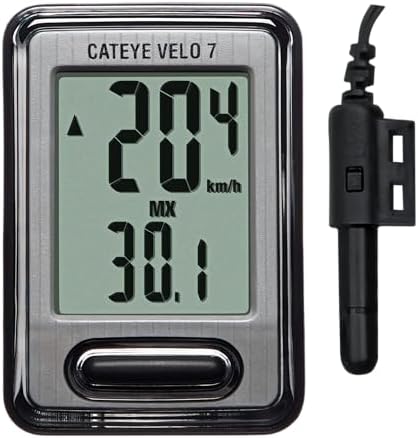
If you just want to know how fast and how far, a simple wireless computer with a wheel sensor does the job for the price of a couple of inner tubes. There is no GPS and nothing to upload, but the numbers are instant, the battery lasts for many months, and setup takes ten minutes. It is the right spend if you ride the same local loops and track progress in your head or a notebook.
Road riders who want GPS recording and app uploads
Once you care about routes, segments and training history, you need a GPS unit that syncs to a phone app. Budget GPS computers record accurate tracks, show speed, distance, elevation and time, and push rides to platforms such as Strava automatically. You trade away detailed maps and fancy training metrics, but the core data most riders actually review is all there, and the battery usually covers a week of riding between charges.
Mountain bikers who need durability more than features
Trail riding punishes electronics with vibration, mud and the occasional trip over the bars. A compact GPS unit with a strong quarter turn mount, a screen that stays readable in dappled light, and buttons that work with gloves beats a larger touchscreen at this price. Our guide to the best bike computer for mountain biking covers the protection and mounting details that rough trails demand.
GPS recording versus simple wheel sensor units
This is the dividing line in the whole category. Sensor based units measure wheel rotations, so they are precise for speed and distance and never lose signal in tunnels or forests, but they record nothing about where you went. GPS units draw your route on a map, capture elevation, and feed your training apps. If you explore new roads or want a ride history, GPS is worth the step up. If your riding is a fixed commute or loop, a sensor unit tells the truth for far less money.
Sensor compatibility: ANT+, Bluetooth and what pairs
A budget computer becomes a training tool when it reads external sensors. Check for both ANT+ and Bluetooth Low Energy support, because sensor brands split between the two. Speed and cadence sensors refine your data, a heart rate strap adds effort tracking, and some units at the top of the budget range even read power meters. Remember that heart rate and power figures are training information only; a bike computer is not a medical device and cannot judge your health or fitness to ride.
Battery life and charging
Simple wireless units sip power from a coin cell that can last a year or more. GPS models use rechargeable batteries rated anywhere from about 15 to 40 hours, with real life use landing lower when the screen backlight and sensors run constantly. For most riders, 20 honest hours covers a full week of training. Check the charge port too: USB C is becoming standard, and a unit that charges from the same cable as your phone is one less thing to pack for a trip.
Navigation: breadcrumb trails versus real maps
Budget GPS units usually offer breadcrumb navigation, which draws your route as a line you follow without street names or a base map. It works surprisingly well for preplanned routes and alerts you when you stray off course. Full color maps with turn by turn street guidance live in the price tier above, covered in our guide to the best gps bike computer models. Decide honestly: if you mostly ride known roads and load the occasional new route, breadcrumb guidance is enough for most people.
Display size, readability and controls
A budget screen earns its keep if you can read it at a glance in bright sun and in rain. Look for strong contrast, large digits for your two or three key fields, and a backlight you can set to stay on during night rides. Button controls beat touchscreens at this price, because inexpensive touch panels often misread wet or gloved fingers. Customizable data pages matter as well: the ability to put speed, distance and heart rate on one screen means fewer button presses at speed.
Mounts and app sync
The mount decides whether your computer survives the ride and stays where you can see it. Quarter turn systems shared across a brand family let you swap the unit between bikes, and many budget models include both a stem mount and an out front mount in the box. App sync should be painless: automatic upload over Bluetooth when you finish, firmware updates through the same app, and route loading that does not require a computer science degree. If syncing is a chore, you will stop doing it, and the data habit dies with it.
Ten careful minutes at setup saves a season of odd numbers. For sensor units, enter your exact wheel circumference rather than the generic chart value, and mount the magnet and sensor with the small gap the manual specifies. For GPS units, let the device sit outside with a clear sky view for a few minutes on its first ride so it can build a full satellite picture. Pair sensors one at a time and name them by bike if you own more than one. Finally, ride a measured mile and compare: if the computer disagrees with a known distance, adjust the wheel size or check the sensor position before trusting its totals.
- Paying for GPS when you only ride one fixed loop, or skipping GPS when exploring new routes is the whole point of your riding.
- Assuming every budget unit pairs with your existing sensors, then discovering it speaks neither ANT+ nor the right Bluetooth profile.
- Leaving the backlight on full brightness at all times, which can cut real battery life to a fraction of the rating.
- Mounting the unit loosely or skipping the safety tether, so the first pothole or crash launches it into the road.
- Judging a computer by screen size alone, when readability in sunlight matters far more than an extra fraction of an inch.
- Forgetting to check what the companion app costs or locks away, since some brands keep advanced analysis behind a subscription.
Rinse off road salt and trail mud with a damp cloth rather than a hose, and keep the charge port cover closed whenever you ride. Store the unit indoors instead of leaving it on the bike in a hot car or freezing garage, both of which age the battery. Top up the charge after long rides instead of running it to zero every time, and swap coin cells in sensor units at the first sign of fading readings. Keep the firmware current, because updates often fix GPS and battery bugs. If you prefer a cable free cockpit without GPS at all, our guide to the best wireless bike computer models covers the simplest end of this category.
Are budget bike computers accurate enough for training?
Yes. GPS units at this price use the same satellite systems as premium models, so speed and distance land within a percent or two on open roads. A calibrated wheel sensor is even steadier for instant speed. Where budget units fall behind is extras such as advanced recovery metrics and mapping detail, not the core numbers most riders train with week to week.
How long does a budget bike computer battery last?
Expect about 15 to 40 hours of GPS recording per charge depending on screen settings and how many sensors are connected, and many months from a coin cell powered wireless unit. Cold weather shortens both. For a multi day tour, carry a small power bank and charge during a long lunch stop; most units sip so little power that a partial top up covers the afternoon.
Can a budget bike computer show me where to turn?
Most can guide you along a route you loaded in advance, using a breadcrumb line and off course alerts. What they generally cannot do is reroute you on the fly with street names the way full mapping units can. If your riding is planned routes and club loops, breadcrumb guidance handles it well. Riders who improvise in unfamiliar cities should budget for a mapping model instead.
Do I need speed and cadence sensors with a GPS computer?
Not to start. GPS gives you speed and distance on its own, and that is plenty for the first season. Add a cadence sensor if you begin structured training, because pedal rhythm is something GPS cannot measure. A heart rate strap is the other worthwhile addition, and it teaches pacing better than any number on the screen, as long as you treat the figures as training guidance rather than medical information.
Will a budget bike computer fit on my handlebar?
Almost certainly. Budget units ship with mounts for standard round bars and stems, and the quarter turn pattern used by major brands has adapters for aero bars and mountain bike setups. Check the box contents before ordering if you want an out front mount, since budget models sometimes include only a basic stem mount and sell the nicer bracket separately.
Pick the simplest unit that records what you will actually review: speed and distance, or full GPS routes with sensor data. Stay inside that line and the best budget bike computer for your riding costs less than a set of good tires. Compare the tiers in the product table above, and for the full category picture see our guide to the best bike computer options at every price.


Best Bryton Bike Computers of 2026: Which Type Should You Buy?

Best 16 oz Water Bottles (2026): Cage Fit, Lids and Insulation
Best Bike Computer for Beginners (2026): Buying Guide

Best Action Camera for Vlogging in 2026: Film the Ride, Tell the Story

Best Bike Pedals for Road Bikes in 2026: Buying Guide and What to Check

Best Bike Seat Cushions: Padding, Sizing, and When They Help

Best Bike Computer for Bikepacking (2026): Buying Guide

Best Action Camera for Scuba Diving (2026): A Buying Guide for Divers